

News
Tackling child malnutrition in northeast Nigeria: Fatima and Ali’s story
n northeast Nigeria, prolonged conflict and displacement have severely disrupted food systems, healthcare and livelihoods, leaving children under five and pregnant and breastfeeding women particularly vulnerable to malnutrition.
Publié le 18/09/2026 | Temps de lecture : 5 min
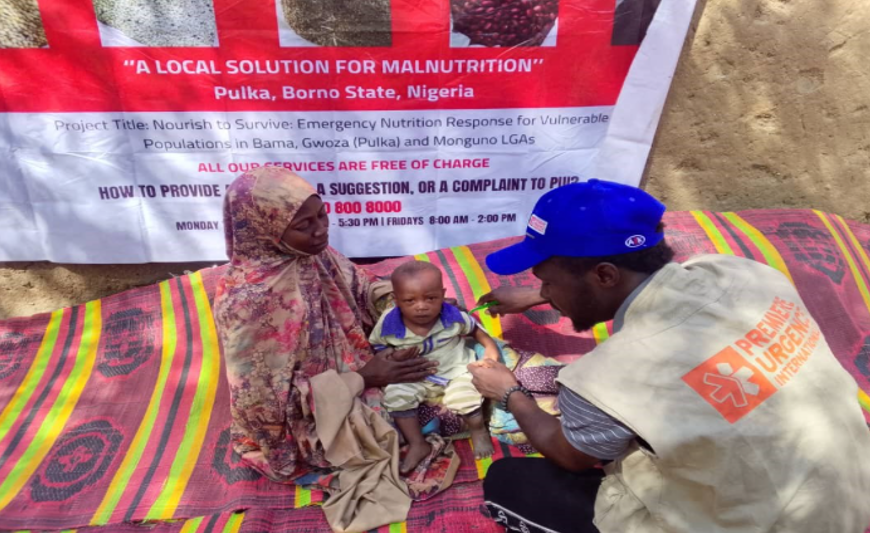
Through a community-based nutrition programme, Première Urgence Internationale is helping families identify malnutrition early, improve feeding practices and prevent moderate cases from becoming severe. In Pulka, this support helped 22-year-old Fatima care for her son Ali and accompany him on his path to recovery.
A critical nutrition crisis in northeast Nigeria
In northeast Nigeria, prolonged conflict and displacement have disrupted food systems, access to healthcare and livelihoods, increasing the risk of malnutrition among the most vulnerable populations.
In 2025, 6.4 million children were affected by acute malnutrition across northeast and northwest Nigeria, including 4.4 million experiencing moderate acute malnutrition (MAM) and 2 million facing severe acute malnutrition (SAM). Borno State remains particularly affected, with a Global Acute Malnutrition rate of 15.7%.
In 2026, Bama, Gwoza and Monguno, three Local Government Areas where Première Urgence Internationale operates, were classified in IPC Phase 4 for acute malnutrition, reflecting a critical situation.
Preventing moderate malnutrition from becoming severe
In response, Première Urgence Internationale launched a project in November 2025, with support from the Nigeria Humanitarian Fund (NHF), managed by OCHA, targeting 2,880 children with moderate acute malnutrition in Bama, Pulka and Monguno.
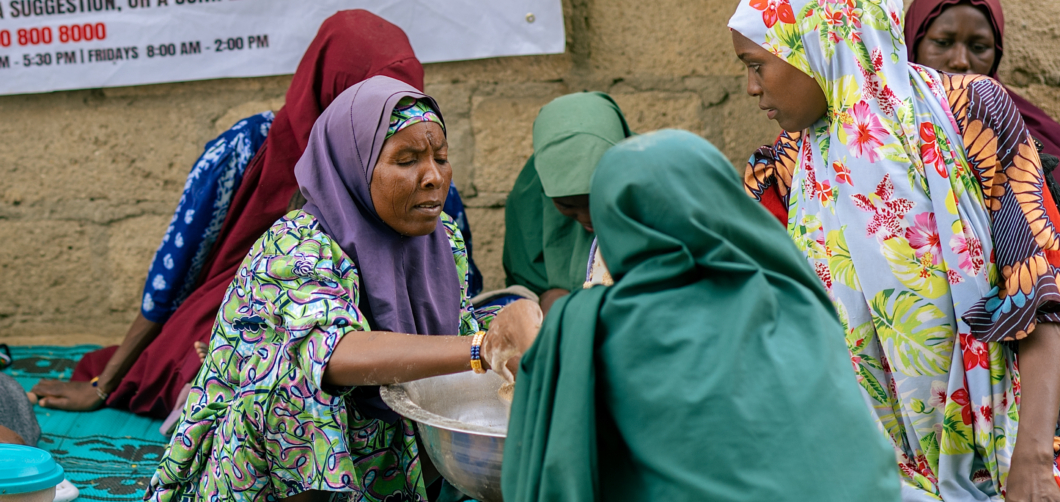
At the heart of the programme is the Tom Brown approach, a community-based method that brings together caregivers of children under five affected by moderate acute malnutrition.
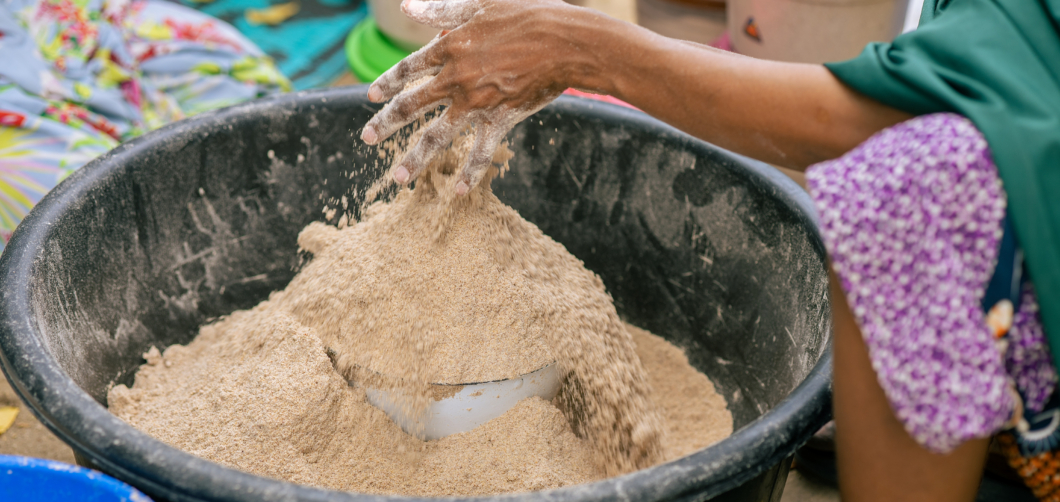
Lead caregivers learn how to prepare nutrient-dense, culturally appropriate recipes using locally available ingredients before sharing their knowledge with other members of their peer group. Families also receive the utensils and supplies needed during the eight-week programme.
The groups provide a space to discuss good nutrition practices and learn how to use mid-upper arm circumference (MUAC) tapes to detect signs of malnutrition in children. By strengthening knowledge at household and community level, the programme aims to identify malnutrition earlier and prevent moderate cases from deteriorating into severe acute malnutrition.
More than 2,800 children supported
The project concluded in May 2026. All 2,880 children with moderate acute malnutrition enrolled in the programme received support, with a 98.3% recovery rate.
Over the course of the project, 20,136 children under five were screened for malnutrition, while 1,920 caregivers learned how to use MUAC tapes, helping families identify warning signs and seek care when needed.
In addition, 7,687 caregivers were reached with information on maternal, infant and young child nutrition.
The project also established 117 peer-to-peer groups, including 33 “Father-to-Father” groups designed to encourage greater involvement of men in nutrition and shared childcare responsibilities.
For Fatima, support came at a critical time
Fatima Musa, 22, is a single mother from Bama, in Borno State. After escaping captivity by armed groups, she resettled in Pulka, Gwoza, with her 13-month-old son Ali and without relatives or a local support network.
Food insecurity made her situation particularly difficult. Fatima sometimes went to bed hungry and struggled to breastfeed her son adequately.
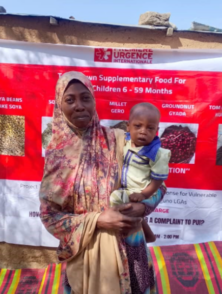
“I escaped from the bush and came here alone. I have no family with me, no one to help me. There were nights I slept hungry, and I could feel I was not producing enough milk for my baby. I did not know where to go or who to ask for help.”
During a routine community screening conducted by Première Urgence Internationale’s Community Nutrition Mobilizers, Ali was identified as malnourished. His MUAC measured 11.7 cm, and he was enrolled in the Tom Brown programme.
Fatima Musa and her son during screening at Transit Camp, Pulka, Gwoza LGA, on 31 December 2025. Ali’s MUAC measured 11.7 cm.
Eight weeks later, a visible recovery
As Fatima took part in the programme, she learned new ways to feed her child and protect both his health and her own. The peer group also gave her an opportunity to connect with other mothers facing similar challenges.
“The training taught me things I had never known before. How to feed my child properly, how to take care of my own health so I can take care of him. Being with the other mothers also helped me. I did not feel so alone anymore.”
Fatima Musa during the first week of the programme at Transit Camp, Pulka, Gwoza LGA, on 1 April 2026.
Four weeks into the programme, Ali’s MUAC had increased from 11.7 cm to 12.3 cm. Fatima was already noticing changes in his everyday life: he was growing and becoming more active.
Fatima Musa and her son during the week-four MUAC follow-up at Transit Camp, Pulka, Gwoza LGA, on 22 April 2026.
After eight weeks, Ali’s MUAC reached 13.3 cm.
“My son is growing now. I can see the difference. He is more active, and I am able to breastfeed him better than before. I am grateful for PUI and everyone who has helped us.”
Fatima Musa and her son after eight weeks of the programme at Transit Camp, Pulka, Gwoza LGA, on 18 May 2026. Ali’s MUAC measured 13.3 cm.
Today, Fatima continues to face the challenges of displacement and raising her son alone. But the programme has provided her with practical knowledge she can continue to use to support Ali’s nutrition and development, as well as connections with other caregivers in her community.
For families like Fatima’s, preventing malnutrition is not only about responding when a child becomes ill. It is also about giving parents and caregivers the knowledge and tools to recognise the warning signs early and protect their children’s health over the longer term.
Our financial donors
Nigeria Humanitarian Fund (NHF)
Nigeria Humanitarian Fund (NHF)