

News
Ensuring emergency care in Ukraine to protect civilians
In Petropavlivka, in the Dnipropetrovsk region, heroism also wears a white coat. Under the constant threat of bombardment, Première Urgence Internationale, with the support of France’s Crisis and Support Center of the Ministry for Europe and Foreign Affairs (CDCS), deployed a vital training program for local healthcare workers.
Publié le 28/04/2026 | Temps de lecture : 6 min
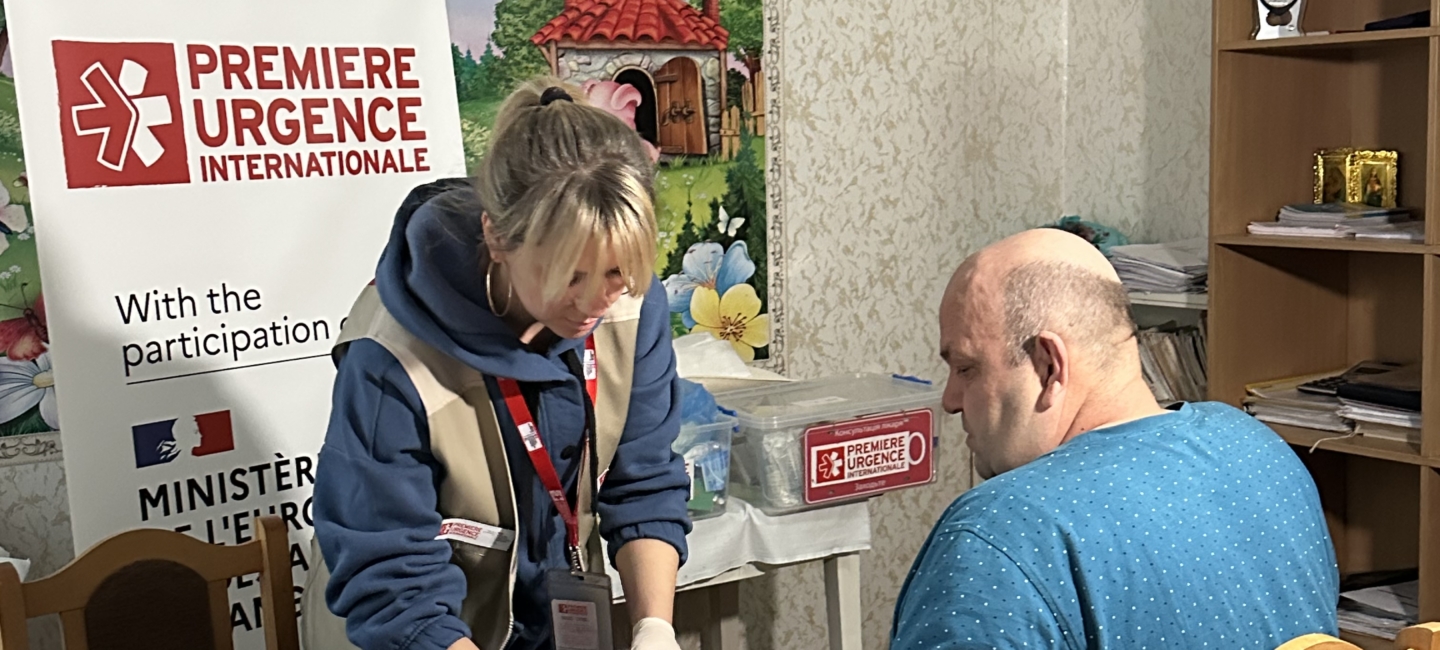
The goal? To ensure that every healthcare professional masters life-saving techniques, even in the midst of chaos.
How do you provide first aid in a war zone?
Theory pales in comparison to the reality on the ground. In Petropavlivka, organizing a session on emergency care in Ukraine is a logistical and security challenge. Faced with the risk of airstrikes, the training took place in the narrow corridor of a health center, adhering to the “two-wall” safety rule, i.e. remaining within two walls of separation from the outdoors.
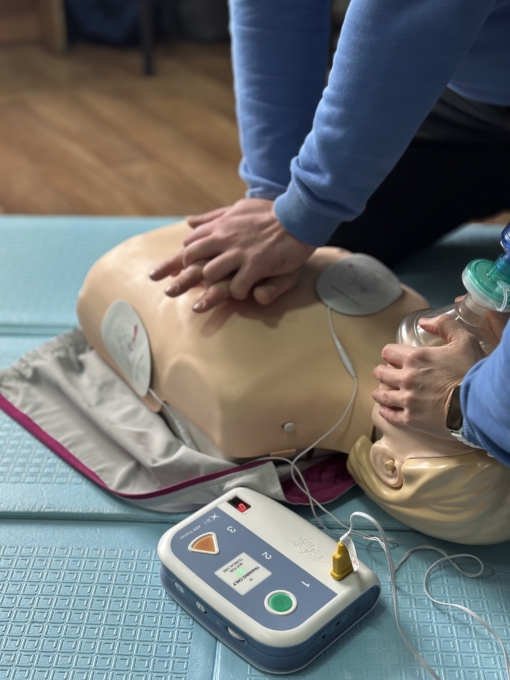
Despite the cramped space, the noise, and the tension of air raid alerts, the medical teams did not back down. They followed the rigorous protocols of the European Resuscitation Council and the American College of Surgeons to master two pillars of survival:
- Basic Life Support (BLS): Basic resuscitation maneuvers.
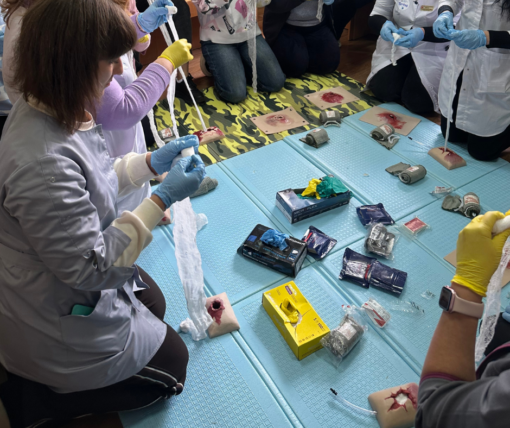
- Stop the Bleed (STB): Emergency techniques to stop massive bleeding.
Why train senior healthcare workers in remote areas?
In this community, a large portion of the medical staff is of retirement age. For these healthcare workers, traveling to major cities poses physical and safety challenges. By bringing expertise directly to them, Première Urgence Internationale ensures that no area is left behind.
During the eight-hour training session, two explosions rang out in the city. Yet, not a single participant left their post. Concentration remained total: here, learning is not a luxury; it is a tool for survival.
Turning fear into life-saving reflexes through simulation
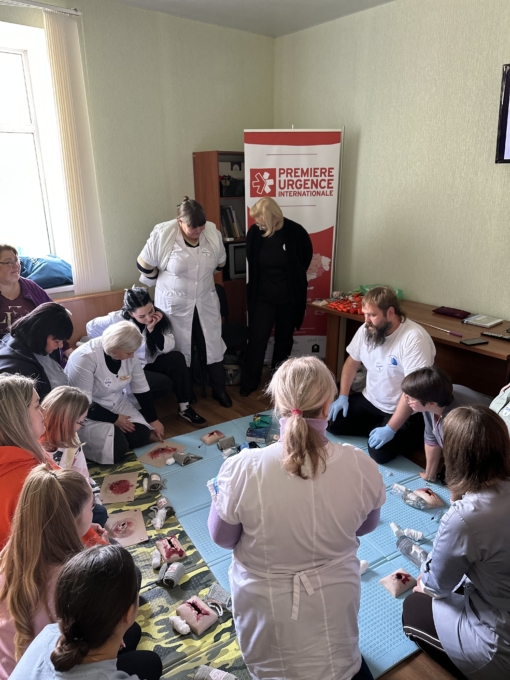
The director of the local health center (PHCC) highlights a historic first for her facility. Beyond knowledge transfer, this day helped break down psychological barriers.
- Overcoming apprehension: Intensive practice helps overcome a lack of confidence when dealing with complex war injuries.
- Building team cohesion: Working through structured protocols transforms a group of healthcare providers into a coordinated response unit.
- Accessible supplies: To embed this change, the NGO provided trauma kits and individual first-aid kits, now readily available at every workstation.
For them, this session was “a breath of fresh air”, an opportunity to update critical knowledge needed in wartime and to organize effective team work.
On the same day after the training, the director personally called Première Urgence Internationale to express gratitude for conducting the training.
More about:
- Our missions in Ukraine
- Our expertise in health
- Our savoir-faire en santé mentale
Our financial support