

News
Saving lives beyond the front lines: the incredible evacuation of hospitals in Ukraine
How can entire hospitals be moved under bombardment to continue providing care? In the Donetsk Oblast, two hospitals were evacuated urgently as fighting intensified. Discover how 138 trucks, humanitarian partnerships, and unwavering determination saved lives and an entire healthcare system.
Publié le 24/12/2025 | Temps de lecture : 8 min
The medical pillars of the Donetsk Oblast: Pokrovsk and Lyman in the face of war
Before the conflict, the hospitals in Pokrovsk and Lyman were the medical lungs of the Donetsk Oblast.
- Pokrovsk Hospital: 700 healthcare professionals, unique expertise in perinatal care, and a coverage area of 400,000 inhabitants.
- Lyman Hospital: A strategic local center, already tested by a first evacuation in 2022.
Despite their proximity to the front line, these facilities held out for two years. But in 2024, the danger reached a new level: drones flew over the operating rooms and attacks directly targeted staff. The situation became tragic: a doctor lost a leg in a strike. The mission to provide care had become a suicide mission.
A historic decision: Move everything so nothing is lost
In the summer of 2024, the order came down: mandatory evacuation. Pokrovsk is 20 km from the front line, Lyman only 10 km. The director of the Pokrovsk hospital, Yurii Vasylievich, refused to abandon his state-of-the-art equipment.
“If we lose the equipment, we lose the hospital. It would be impossible to rebuild it from scratch,” explains Inna Vladymyrovna, director of the Lyman hospital.
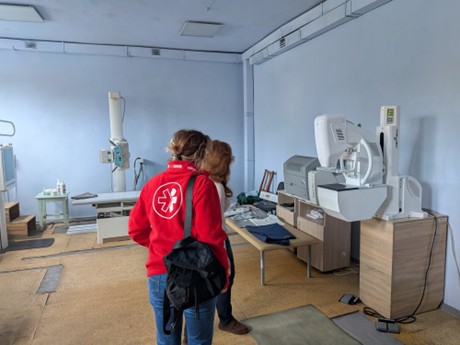
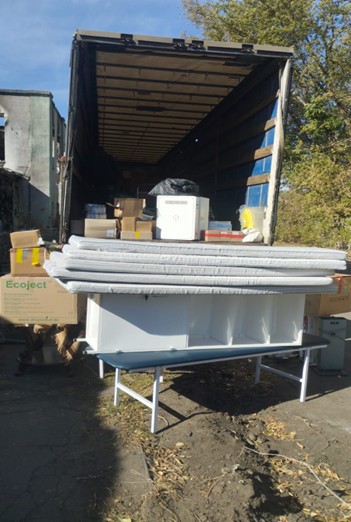
Rather than fleeing with a few boxes, these teams attempted the impossible: transferring 95% of their equipment, from high-tech surgical equipment to the accounting department.
A logistical operation: 138 trucks to safety
The rescue was made possible thanks to a rapid collaboration with the NGO Première Urgence Internationale and the Health Cluster in Ukraine.
- The size of the convoy: 138 trucks were mobilized.
- The value saved: Nearly $4 million (156 million UAH) worth of medical equipment.
- The timing: The last truck left Pokrovsk under bombardment. Twenty-four hours later, the operation would have been impossible.
Funding was provided by US Foreign Assistance for Pokrovsk and by the Ukraine Humanitarian Fund (UHF) for Lyman, coordinated by the Ukraine Health Cluster, proving the effectiveness of international partnerships in emergencies.
A new life in Kryvyi Rih: Reducing healthcare saturation
The two hospitals found refuge in Kryvyi Rih, the country’s eighth largest city. The arrival of these facilities was a real breath of fresh air for the local healthcare system, which was on the verge of collapse.
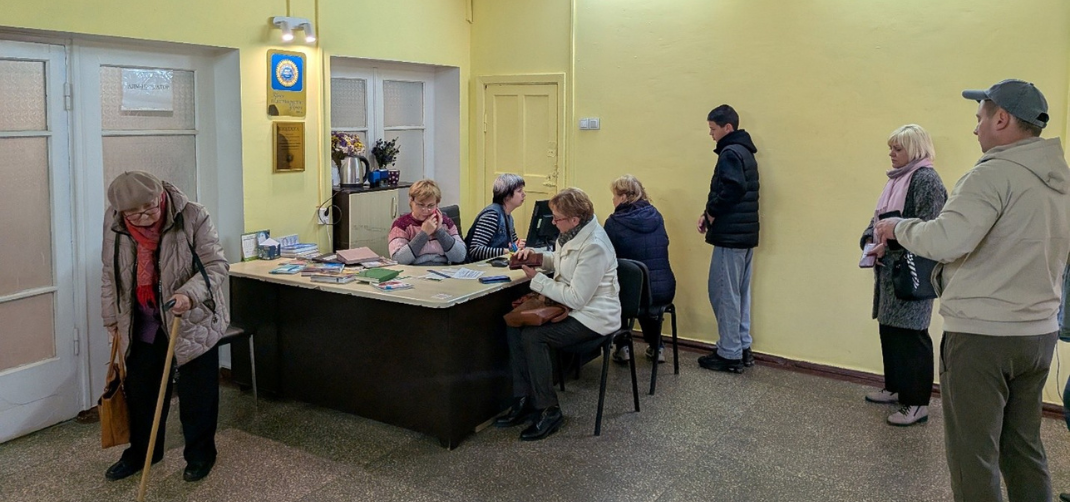
The hosptals were the target of frequent drone attacks before the evacuation.
Today, Pokrovsk Hospital provides 10,000 consultations per month. Inpatient services reopened in record time (six weeks) and the operating rooms will be fully operational by 2026. Lyman, for its part, continues to provide outpatient care while awaiting permanent premises to restart its surgical services using the equipment that was saved.
More about
Financial support