

News
Ensuring sustainable healthcare for children throughout the Alibori department, in Benin
How to ensure sustainable healthcare for children in Benin : thanks to free medical care, Aïssatou survived malaria and malnutrition.
Publié le 11/02/2026 | Temps de lecture : 4 min
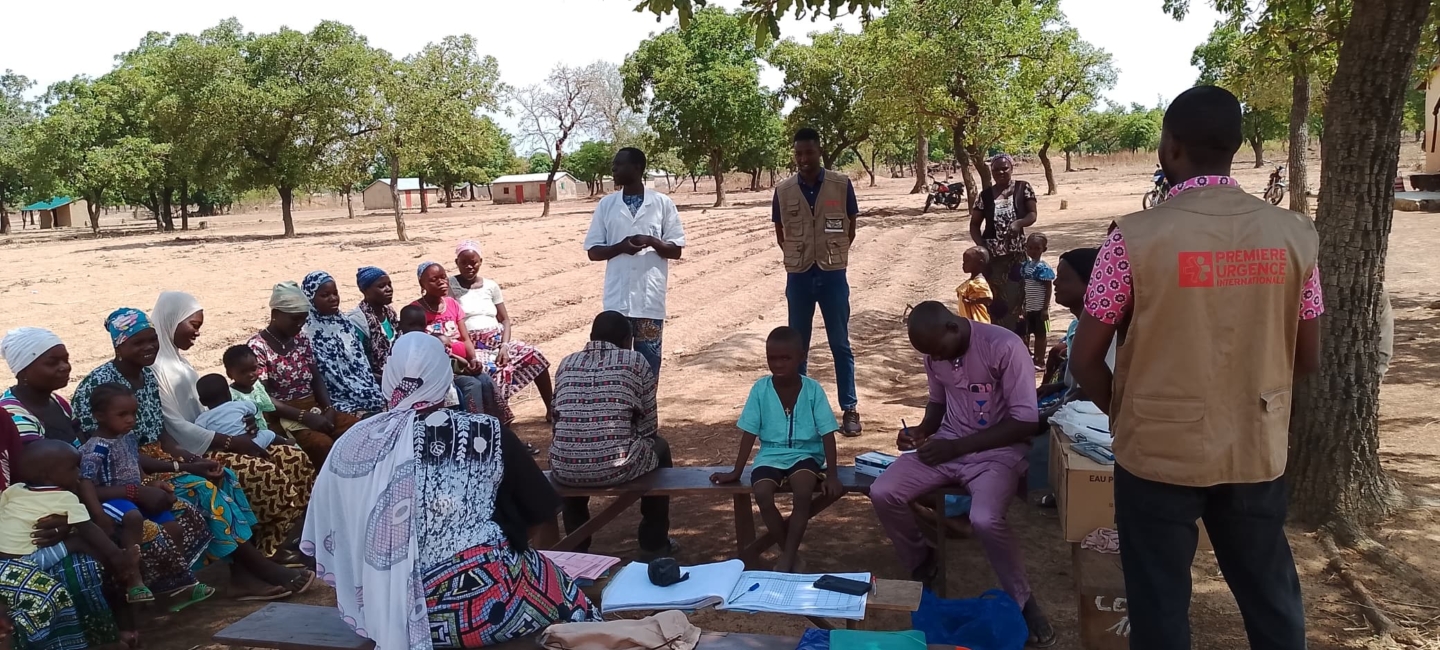
The challenge of accessing healthcare in Alibori
In northeastern Benin, poverty and insecurity make access to healthcare a real challenge. For the most vulnerable families in the Alibori department, where children under five and displaced populations are particularly vulnerable to nutritional and health crises, the cost of treatment is often prohibitive.
Koffi’s story: breaking the silence of disease
Koffi Agossou’s family is a case in point. Dependent on subsistence farming, they could not afford to treat their three-year-old daughter Aïssatou, who was suffering from severe malaria, tuberculosis, and malnutrition.
“I saw my child constantly running a fever, with spots all over her body… Due to a lack of resources, I had to make do with the care provided by ‘traveling doctors’: 1,000 francs here, 1,600 francs there… But her condition remained unchanged, sometimes even worsening,” says Koffi, Aïssatou’s father.
The impact of free healthcare and community support
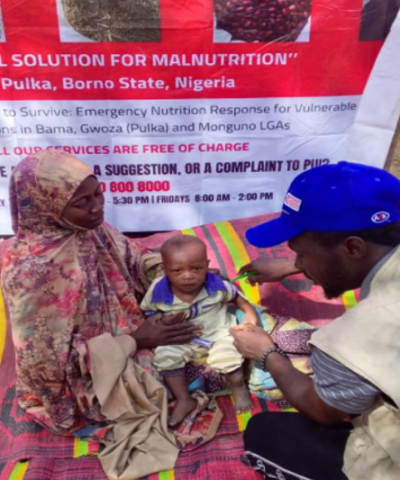
It was the intervention of a Première Urgence Internationale Community Health Officer that changed everything. By restoring confidence and guaranteeing completely free treatment, we were able to provide comprehensive medical care with the participation of the Crisis and Support Center of the Ministry of Europe and Foreign Affairs.
Thanks to this support, Aïssatou was able to receive free emergency antimalarial treatment, tuberculosis treatment, and nutritional monitoring for two weeks. The Community Health Officer also provided logistical and psychosocial support to the parents. Upon leaving the center, there was a clear improvement: the fever had disappeared, her appetite had returned, and Aïssatou had resumed her normal childhood life. To ensure a full recovery, treatment is now continuing at home with regular community follow-up.
“At first, we were a little skeptical, but we decided to trust them… and we did the right thing. I never thought my daughter would smile again. Thanks to your support, she is alive today,” recalls Koffi.
A definitive solution to infant mortality
Thanks to this model combining community support, free healthcare, and psychosocial follow-up, Aïssatou is now out of danger. This system does more than just provide treatment: it instills lasting health habits within communities, ensuring that no child is left behind because of poverty.
More about:
Financial support